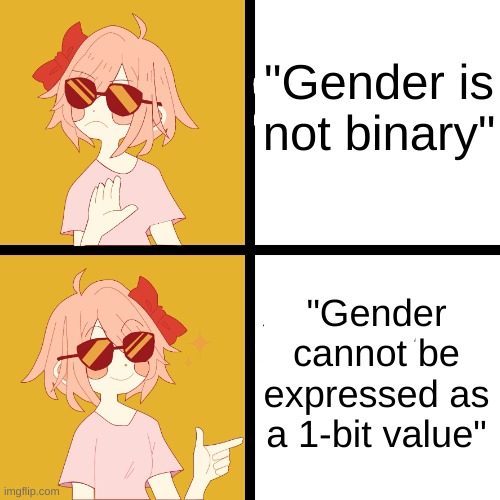
HiddenLayer555@lemmy.ml to Programmer Humor@lemmy.mlEnglish · 1 year agoI have a 64-bit genderlemmy.mlimagemessage-square89fedilinkarrow-up1510arrow-down154
arrow-up1456arrow-down1imageI have a 64-bit genderlemmy.mlHiddenLayer555@lemmy.ml to Programmer Humor@lemmy.mlEnglish · 1 year agomessage-square89fedilink
minus-squareRentlar@lemmy.calinkfedilinkarrow-up27·1 year agoCan it be expressed or represented approximately in IEEE-754 form?
minus-squaredavel [he/him]@lemmy.mllinkfedilinkEnglisharrow-up41·edit-21 year agoAlways approximated, never truly represented 😞
minus-squareLegoBrickOnFire@lemmy.worldlinkfedilinkarrow-up7·edit-21 year agoUnless your encoding has a special value that, by definition, is euler’s constant :p
minus-squaredavel [he/him]@lemmy.mllinkfedilinkEnglisharrow-up5·1 year agoGood point. Specifically code point U+2107 https://en.wikipedia.org/wiki/ℇ
minus-squareidunnololz@lemmy.worldlinkfedilinkarrow-up5·1 year agoAh so ur gender can be represented in UTF 8.
minus-squareReginaPhalange@lemmy.worldlinkfedilinkarrow-up1·11 months agoNo taxation without approximation!
minus-squareValmond@lemmy.worldlinkfedilinkarrow-up20·1 year agoEverything can be represented approximatively. e = π = 3


Can it be expressed or represented approximately in IEEE-754 form?
Always approximated, never truly represented 😞
Unless your encoding has a special value that, by definition, is euler’s constant :p
Good point. Specifically code point U+2107 https://en.wikipedia.org/wiki/ℇ
Ah so ur gender can be represented in UTF 8.
No taxation without approximation!
Everything can be represented approximatively.
e = π = 3