

57·
13 days agoYou’re just a Nazi that wants to force all Jews to move to Israel.
You’re just a Nazi that wants to force all Jews to move to Israel.
Oh, I figured it out. They broke their FAQ/wiki for old reddit.
Is there any actual content on that wiki? I’m not seeing any actual content there.

When these get deployed, they’ll finally implement eyeball tracking into the ads. Some smart TVs have in built cameras, and this could easily be one the norm. The companies so far have been too afraid to use it, but the tech has existed for years at this point. Technically, there’s nothing stopping YouTube from just requiring users to have an iris tracking camera enabled. And this would defeat a smart glasses AI ad filter. I suppose you could maybe have a screen on the front that projected fake eyeballs towards the camera, but maybe they could then defeat that.
Or, more likely, they’ll just lobby Congress to ban ad blockers and and blocking devices.
What’s worse is this even makes attending the game in person miserable. I know many very passionate college football fans who show up hours before the game to hang out with friends, and then more times then not end up leaving the game itself early. Why? Because the game itself is a drag. If a game is televised, they add extra breaks to the game to accommodate ads. The game gets stretched out from something of reasonable length to some absurd 3-4 hour long slog. People then only stick around if the winner remains unclear. If the games were a more reasonable 2 hour length, with more engaging and constant action, then most folks would stay to the end.

If you’re involved in any kind of protest, the phone number of a lawyer. Hell, generalize this. Make sure you memorize numbers of at least the first few of your emergency contacts. You never know when you will be separated from your phone.
All technologies have military and civilian use. Just because you can’t think of a civilian application for precision gyroscope doesn’t mean others can’t. Precision surveying immediately comes to mind as a potential application, plus civilian inertial navigation devices.
And no, there is not some magical level of precision that only the military has use for. If something has military applications, it also has civilian ones. Hell, there are potential peaceful applications of nuclear bombs. If those can be a dual-use technology, anything can be.
Yeah, let’s voluntarily lower the quality of all of our lives simply to give some minute advantage in the geopolitical chess game.
I used to put it on my resume and the kind of offers I would get…where VERY bad. Or had some huge red flags.
In what way, someone looking for people to hack old banking systems?
deleted by creator
I use the k cups and brewer with a reusable washable pod. You put little paper filters in them.

I’m surprised they haven’t just started building 5g chips right into the tvs. That’s the end goal here. Just make it so the devices don’t even need your cooperation to phone home.
If you’re not woke, you’re asleep.

You have to post anything a fascist would hate. Fascists love undesirables killing themselves.
Sorry, best I can do is the sci fi dystopian option where we grow entire cows in vats, but we make it humane by just growing them without brains.
Yeah, this is one of those areas that capitalism really screws us over.
The natural and most obvious use for these lab-grown and imitation meats are for filler meats. Think a ground beef replacement. Something that would be added to a casserole, a burrito, or any other dish where meat is present, but not the primary focus of a dish.
But it costs money to develop lab-grown meats. And to pay that investment back, for-profit companies have to target the luxury market first. It’s like how Tesla started with building an expensive sports car. Then they used the profits from that to build a cheaper next generation car, and so on. That’s what the lab grown meat companies have had to do. The ideal market for products like these would be things like chicken nuggets or the meat inside hot pockets. But those are also the cheapest form of meat sold, and they need to target the upper end of the market to have any hope of profitability.
If it makes you feel better, cows themselves are opportunistic carnivores.
I had two holes down there, but at some point I decided to get another one installed. Unfortunately it was absolutely not a DIY installation. :/

I wonder if crypto coins could serve a similar role here. Except instead of mining, just create the tokens and start the currency by giving every resident an equal share.
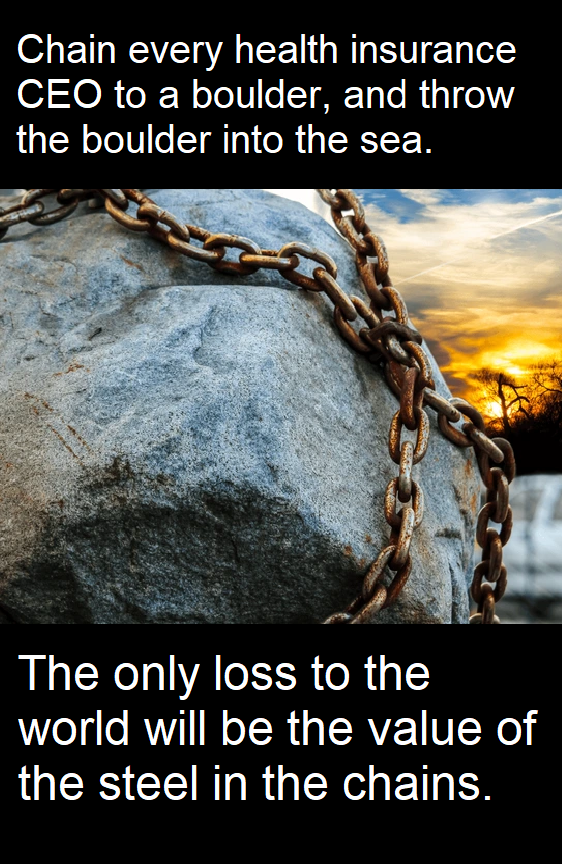
We should pass a constitutional amendment requiring every diplomat visiting the US to French kiss the sitting president at first meeting. You want to meet with Trump? You have to kiss him square on the lips.