

1·
11 days agoThat’s insane… Can’t a website owner require bots (at least those who are identifying themselves as such) to prove at least they’re affiliated with a certain domain?
That’s insane… Can’t a website owner require bots (at least those who are identifying themselves as such) to prove at least they’re affiliated with a certain domain?
I don’t know what “12,181+181” means (edit: thanks @Thunraz@feddit.org, see Edit 1) but absolutely not 1.2181 × 10185. That many requests can’t be made within the 39 × 109 bytes of bandwidth − in fact, they exceed the number of atoms on Earth times its age in microseconds (that’s close to 1070). Also, “0+57” in another row would be dubious exponential notation, the exponent should be 0 (or omitted) if the mantissa (and thus the value represented) is 0.

They check the other requirements too, presumably
Wow, that’s a very informative article! I only knew about Faux Cyrillic, Greek, Vietnamese etc., which are parts of the text transformation, but not about the technique as a whole. I guess I’ll edit the Faux Cyrillic and “faux German” (Metal umlaut) articles to help anyone search for info about a cursed string they saw in a niche setting deep in Windows.
See, I’ve been wanting to make a post about Windows 11 suddenly being like
Are you sure you want to perform this action?
Performing operation 'Μθđїƒý' on Target 'ŞΜЪ Ćľį℮ŋт Čõпƒìğцгăţїõŋ'.
[Y] Yes  [A] Yes to All  [N] No  [L] No to All  [S] Suspend  [?] Help (default is "Y"): _
and I needed the video to provide more context. I guess the Wikipedia article could be enough but it obviously doesn’t show screenshots.
Overall, localization on Windows has gotten worse, there are context blunders that wouldn’t have happened in XP days.
By the way, there was a video by Enderman (or FlyTech, or similar) showing a Windows locale that looked ﻉกƚٱɼєℓץ ʟ𝔦к𝚎 Շዘノร, intended for English-speaking devs to test support for Unicode and unusually short/long strings in the UI. I haven’t been able to find it for years (the title, which was along the lines of “The Strangest Windows 8 Build” didn’t help). Has anyone seen it recently?
They probably also store cryptogrphic and neural hashes of the files to compare later if new CP gets identified.

I’m getting used to Compose and AltGr. Unexpected Keyboard for Android helps learn compose codes by visualizing them but it’s still a bit of resistance. And yes, Compose can also be used to input Unicode hex codes.
Either way, I created a custom layout for AltGr and Shift+AltGr layers that is more convenient for me than remembering Compose and Unicode codes.
Add Windows-like Alt codes to the list. They’re not perfect (they use a DOS codepage and A-F in the Unicode extension clash with shortcuts in other programs like Firefox, although not passing them through via xkb would solve this) but people use them a lot, especially in my country. At? Alt+64. Backtick? Alt+96. Caret? Alt+94. Hash? Alt+38. Musical note? Alt+13. Yes, we can type most of these on the Czech layout with AltGr but people don’t know this and/or prefer things that work on the commonly default English layout too.
I live in the second world and holy shit, people are so wasteful.
Any used tablet with Android will do. Some can be found in the trash even.
The “n” is probably a misprint, AltGr+2 prints “²” and AltGr+3 prints “³” in the German layout; it can be customized to actually print “n” in xkb though.
I mean, if the redundant Windows keys produce different codes, it could be worth a lot to macro enthusiasts. The model exists with an English QWERTY layout too:
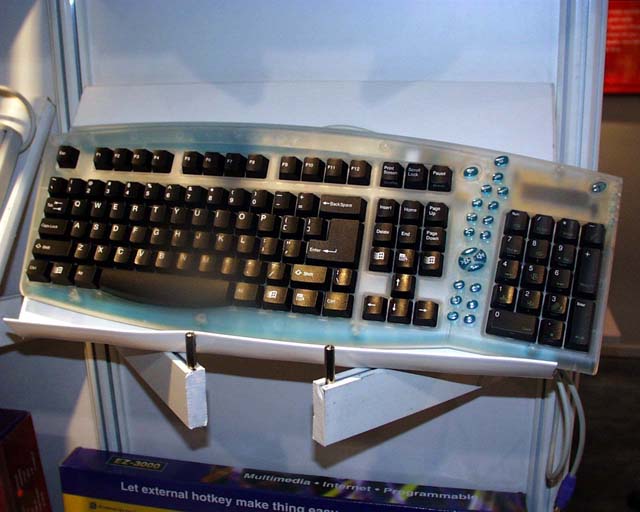
The picture seems to be from 1998 so you’ll likely need a passive DIN to mini-DIN adapter as well.
I did’t know much about the German keyboard layout but I know the Czech one, which is derived from it (we both use QWERTZ) and was able to look up most of what I didn’t know.
So, the keyboard has 4 layers: default, Shift, AltGr, AltGr+Shift (the fourth one is not standard but is recognized by xkb; in Czech I use it for custom character mappings, in German it is standardized but Linux-only).
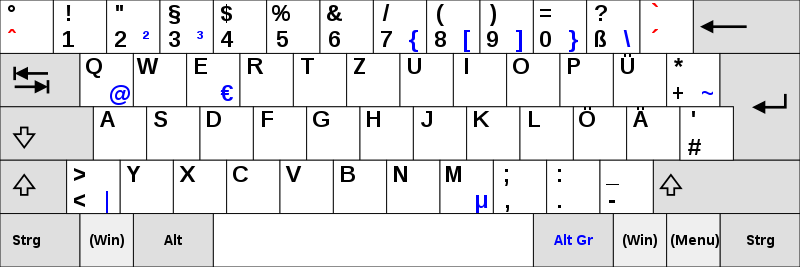
As you can see, AltGr+2 produces ², and AltGr+3 produces ³. I think the full-size “2” and “n” are misprints. My old Czech keyboard has some errors too.
By the way, Czech is more chaotic:
´, ˇ, ˚, ¨) like on typewriters
˚ key twice prints the degree sign (°) twice (Windows) or once (Linux)§ key but we need to press AltGr+7 twice, then backspace (or Alt+96) for a grave (`), which is part of ASCII and used in Markdown€); it contains useful symbols ([]{}<>|\€$@#^&×÷`) as well as useless ones (Đđ – these are Slovene, why not the Slovak Ôô?), leading people to prefer Windows-only left-Alt+numpad codes (such as Alt+64 for @) that use the obsolete OEM-1252 codepage (the Unicode extension has to be enabled via registry and Alt+letters hex codes get passed to programs anyway, often defocusing the input element). I only found a Slovak one on Wikimedia CommonsDo you know why the 3 key has an n? I have a hunch:

This is clearly a tactical keyboard for use in military, aviation or maritime navigation systems! /s
Oh, so it does the reverse of what I thought
Why is there a Win-Lock option? I get Caps Lock and Fn-Lock but is there any other reason besides saving a finger for the all-important Win-Ctrl-Alt-Shift-L shortcut to open LinkedIn? /s

the second it says “Seeding”
Don’t worry, it will stall at 99.9% forever

Not really, they replaced most electronics inside and it’s just a video.
Also, there is almost always a better source than a brainrot video on most topics.
And what language calls pregnancy tests “predictors”?!
Thanks. “Public” is not a useful qualifier as it could mean decompiled or leaked.


I submitted the mysterious extra
nsituation on military keyboards as a question for Lateral and they featured it in today’s episode!Spotify video • Spotify CDN raw file (34:18) • catbox.moe • Podverse.fm clip • Website with transcript
They reserve the right to edit questions and omitted the important
n-lock key. A keyboard with a permanently missing 3 would be ridiculous.